
Japan has an extensive railway network that makes it easy to travel between major cities, explore local neighborhoods, and discover beautiful countryside destinations. However, if you’re visiting Japan for the first time, navigating the train system can feel a little confusing.
What’s the difference between JR and private railway companies? How do you know which train to take? Do you need a separate ticket for the Shinkansen? And what should you do if you miss your train?
Don’t worry! I’ve put together this practical guide to help you understand Japan’s railway system and travel with confidence.
In this article, I’ll answer 20 common questions about Japanese trains, from finding your platform to handling unexpected problems during your journey.
Whether you’re traveling around Tokyo or taking a long-distance trip across Japan, these tips will help make your train journeys smoother and more enjoyable.
1. Understanding Japan’s Railway System
Q1. What is the difference between JR and private railway companies?
Japan’s railway network is operated by several different types of companies.
JR (Japan Railways) is a group of railway companies that operate across Japan. JR was formed following the privatization of Japanese National Railways in 1987 and is now divided into regional companies, including JR East, JR Central, JR West, JR Hokkaido, JR Shikoku, and JR Kyushu.
JR operates many local trains, limited express trains, and Shinkansen services.
Private railway companies operate their own networks, often connecting major cities with surrounding suburbs and tourist destinations.
For example, Tokyo has several major private railway operators, including Tokyu, Keio, Odakyu, and Tobu.
Subways are another important part of urban transportation. Tokyo has two major subway operators: Tokyo Metro and Toei Subway.
When traveling around Japan, you may need to use several different railway companies during a single journey.
The good news is that many stations offer convenient transfers between different operators, although you may need to pass through separate ticket gates or purchase different tickets.
Q2. What are the different types of trains in Japan?
Japanese trains are classified according to how many stations they stop at and how quickly they travel.
Here are the main types you’ll encounter:
| Train Type | Japanese | What to Expect |
|---|---|---|
| Local | Futsū (普通) | Stops at every station |
| Rapid | Kaisoku (快速) | Skips some stations and usually costs the same as a local train |
| Express | Kyūkō (急行) | Skips more stations; additional charges depend on the operator and service |
| Limited Express | Tokkyū (特急) | Stops at major stations and usually requires an additional limited express ticket |
| Shinkansen | 新幹線 | High-speed trains connecting major cities |
The exact names and fare rules vary by railway company.
For example, a rapid train is often a convenient way to travel between cities without paying extra for a limited express service.
A limited express train, on the other hand, may offer reserved seating and faster connections to popular destinations.
Before boarding, check the train’s destination and stopping pattern. Two trains on the same platform may stop at different stations.
2. Finding Your Way Around Japanese Train Stations
Q3. How can I tell whether a train belongs to JR or a private railway company?
The easiest way is to look for the railway company’s name and logo.
At major stations, you’ll often see separate signs for JR lines, subway lines, and private railway operators.
For example, at Shinjuku Station in Tokyo, you’ll find JR East, Odakyu, Keio, and several subway connections.
Even though these railway lines share the same general station area, they have separate ticket gates and platforms.
When following directions, pay attention to the operator’s name as well as the line name.
This is especially important when using a navigation app because the same destination may be accessible through several different railway companies.
Q4. How do I find the correct platform?
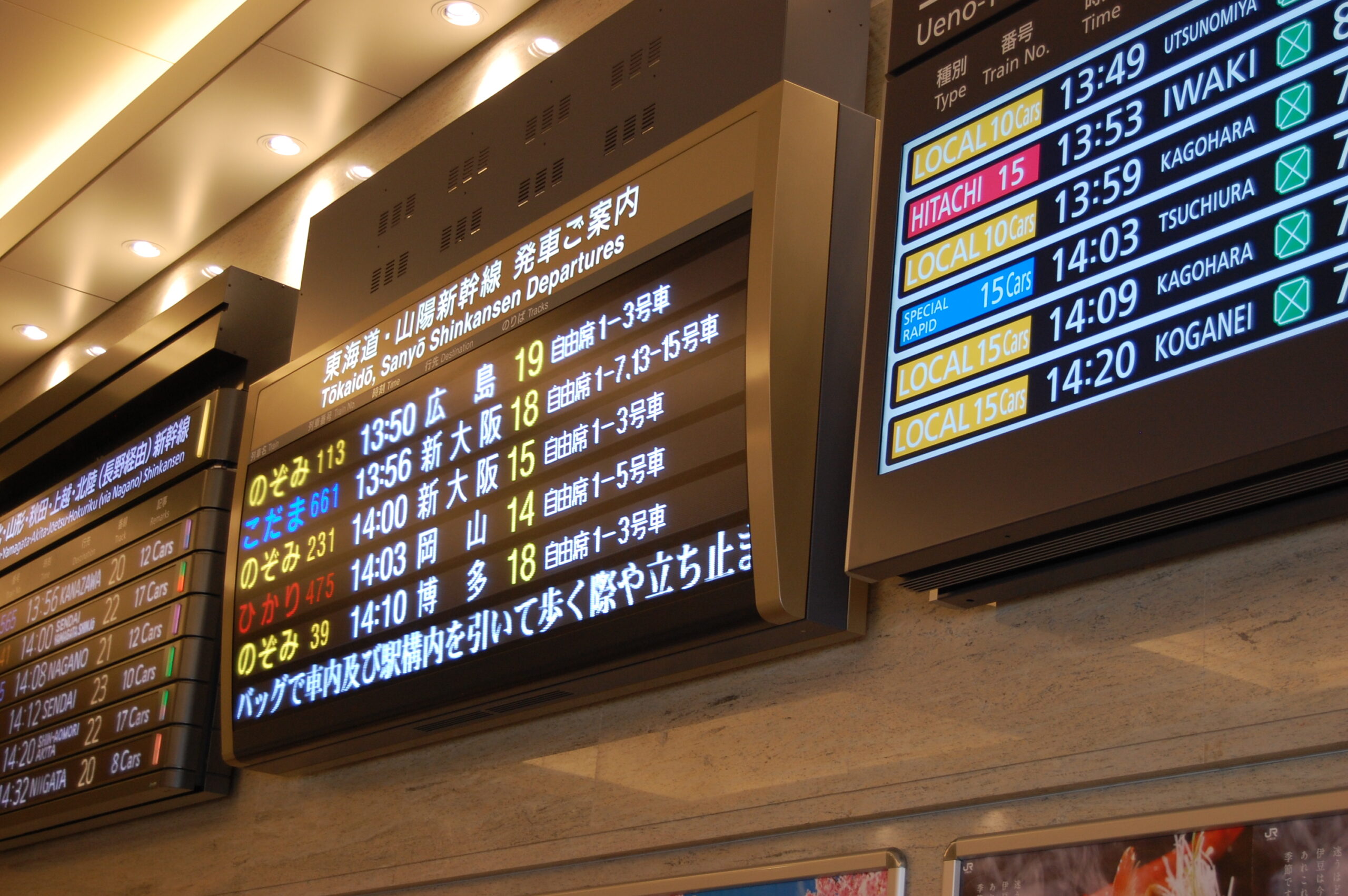
Japanese train stations usually display clear signs showing platform numbers, train destinations, and departure times.
Look for the following information:
- Platform number: The number of the platform where your train departs.
- Destination: The final destination or a major station along the route.
- Train type: Local, Rapid, Limited Express, or another service.
- Departure time: The scheduled departure time.
- Car number: The position of your designated car, if you have a reserved seat.
At large stations, overhead signs and electronic departure boards are available in English as well as Japanese.
If you’re unsure, ask a station employee for help.
One important tip: always check the destination and stopping pattern before boarding. A train traveling in the right direction may still skip your station.
Q5. Which apps can I use to navigate Japan’s train system?
Several apps can help you plan train journeys in Japan.
Google Maps is useful for finding routes, checking departure times, and navigating between stations.
Japan Transit Planner (Jorudan) and NAVITIME are also popular options for checking train connections, transfer times, and fares.
Depending on the app, you may be able to compare routes based on travel time, number of transfers, or cost.
For long-distance journeys, especially those involving the Shinkansen or limited express trains, it’s a good idea to confirm ticket requirements and schedules through the railway operator’s official website.
Train schedules can change, and some services require reservations or additional tickets.
Q6. How do I pass through Japanese train ticket gates?
If you’re using a physical ticket, insert it into the ticket slot at the gate and collect it from the other side.
If you’re using a compatible IC card such as Suica or PASMO, simply tap it on the reader.
For mobile IC cards, tap your smartphone on the designated reader.
At your destination, use the same ticket or IC card to exit.
If you have multiple tickets, such as a basic fare ticket and a limited express ticket, follow the instructions for your particular ticket type.
If the gate doesn’t open, don’t force your way through. Check your ticket or card balance and ask a station employee for assistance.
For more information about IC cards, see my guide to Suica and PASMO.
3. Understanding Shinkansen and Limited Express Trains
Q7. Where do I board the Shinkansen?
The Shinkansen is Japan’s high-speed railway network, connecting major cities across the country.
However, not every station served by conventional JR trains has a Shinkansen platform.
For example, if you’re traveling from Tokyo to Kyoto, you board the Tokaido Shinkansen at Tokyo Station or Shinagawa Station.
If you’re traveling from Tokyo to Sendai, you can board the Tohoku Shinkansen at Tokyo Station or Ueno Station.
Some cities have separate stations for conventional trains and Shinkansen services, while others have platforms within the same station complex.
Before your trip, check the departure station shown on your ticket and follow the signs for the Shinkansen.
Q8. What’s the difference between reserved and non-reserved seats?
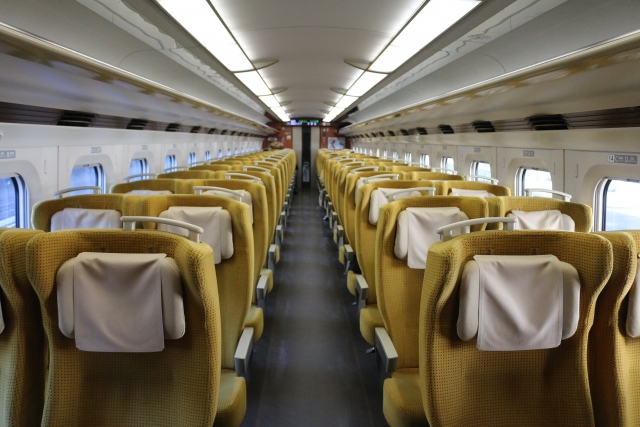
Shinkansen and limited express trains may offer different seating options.
Reserved seats (Shitei-seki / 指定席)
A reserved seat means you have a specific seat assigned to you.
This is a convenient option if you’re traveling with family or friends, carrying luggage, or traveling during a busy period.
Non-reserved seats (Jiyū-seki / 自由席)
A non-reserved seat allows you to sit in any available seat in the designated non-reserved cars.
You don’t have a specific seat assigned to you, so you may need to stand if the train is crowded.
Not every train offers non-reserved seating. Some Shinkansen services operate with reserved seating only.
Green Car (グリーン車)
Green Car is a premium seating class offering more spacious seating and a quieter environment on many trains.
GranClass (グランクラス)
GranClass is a premium class available on selected Shinkansen services, with more spacious seating and, on some services, additional onboard amenities.
The available classes and services depend on the train and route.
Q9. Do I need two tickets to ride the Shinkansen?
This is one of the most confusing things about Japanese train tickets.
A standard Shinkansen journey generally involves two fare components:
- Basic fare ticket (乗車券): Covers the basic cost of traveling between stations.
- Shinkansen limited express ticket (新幹線特急券): Covers the additional charge for using the Shinkansen.
Depending on how you purchase your ticket, these may be issued as two separate tickets or combined into one.
If you’re using a rail pass or an eligible electronic ticketing service, the ticketing process may be different.
When purchasing a Shinkansen ticket, make sure you understand which fare components are included.
Q10. What is the fastest Shinkansen in Japan?
The fastest Shinkansen services in Japan are operated on selected high-speed lines.
On the Tokaido Shinkansen, the Nozomi is the fastest train category, connecting Tokyo and Shin-Osaka with fewer stops than Hikari and Kodama services.
The maximum operating speed of the Tokaido Shinkansen is 285 km/h.
Other Shinkansen lines operate at different maximum speeds, depending on the route and train type.
Remember that a train’s maximum operating speed is not the same as its average speed or the total travel time between stations.
If you’re traveling between Tokyo and Osaka, the Nozomi is generally the fastest option on the Tokaido Shinkansen.
Q11. What happens if I miss my Shinkansen?
If you miss your reserved Shinkansen, the next step depends on your ticket type and the railway operator’s rules.
For many standard reserved-seat tickets, you may be able to use a non-reserved seat on a later train on the same day, subject to the ticket’s conditions.
However, this does not apply to every ticket, and some services have special restrictions.
If your ticket is for a train with reserved seating only, you may need to change your reservation or purchase another ticket.
If you’re using a rail pass, the rules may be different.
My advice: If you miss your train, speak to a station employee before boarding another train. They can explain your options based on your ticket.
If you have reserved oversized baggage space, you may need a new reservation for the next train.
Q12. Can I bring a large suitcase on the Shinkansen?
Yes, but the rules depend on the size of your luggage and the Shinkansen line you’re using.
For the Tokaido, Sanyo, Kyushu, and Nishi-Kyushu Shinkansen, luggage with total dimensions (length + width + height) between 161 cm and 250 cm is classified as oversized baggage.
If you’re carrying oversized baggage on these lines, you generally need to reserve a seat with an oversized baggage area or an appropriate baggage compartment.
There is no additional charge for making the required oversized baggage seat reservation when purchasing the relevant ticket.
If you board without the required reservation, additional charges or other restrictions may apply.
For smaller suitcases, the overhead luggage racks and space around your seat may be suitable, depending on the train and available space.
Baggage exceeding 250 cm in total dimensions is generally not permitted on these Shinkansen services.
Always check the official rules for your route before traveling.
4. Tickets, IC Cards, and Rail Passes
Q13. Can I use an IC card such as Suica or PASMO for every train in Japan?
No. Suica, PASMO, and other major IC cards are accepted across many railway networks, but they cannot be used on every train or in every region.
Some local railway lines and rural transportation services do not support IC card payments.
Also, using an IC card to enter one IC card area and exit in another may not be permitted, even if both areas accept the same card.
For long-distance journeys, you may need a regular ticket or a separate limited express ticket.
Before traveling, check whether your entire route supports IC card payment.
Q14. What should I do if I lose my train ticket?
If you lose your paper train ticket, contact a station employee as soon as possible.
Depending on the ticket type and railway operator’s rules, you may be required to purchase another ticket to continue your journey.
If you later find the original ticket, you may be able to apply for a refund under the applicable conditions.
The rules can vary depending on whether you lost a basic fare ticket, a limited express ticket, or a special discount ticket.
If you purchased an electronic ticket, check the relevant app or booking service for instructions.
Q15. Is the Japan Rail Pass worth buying?
The Japan Rail Pass is a travel pass that allows eligible visitors to use certain JR trains and other included services for a set period.
Whether it’s worth buying depends on your itinerary, the trains you plan to use, and the total cost of individual tickets.
If you’re traveling between several distant cities, a rail pass may be worth considering.
If you’re staying mainly in Tokyo or taking only one or two long-distance trips, individual tickets may be more suitable.
Before purchasing a pass, compare its price with the cost of the journeys you actually plan to take.
Also, check which services are included. Some trains, including Nozomi and Mizuho Shinkansen services, require an additional special ticket when using the nationwide Japan Rail Pass.
5. Practical Tips for Riding Trains
Q16. Can I eat and drink on Japanese trains?
Eating and drinking are generally acceptable on long-distance trains such as the Shinkansen and many limited express services.
Many travelers enjoy an ekiben (駅弁), a special boxed meal sold at railway stations, during their journey.
On local trains and crowded commuter trains, however, eating is generally less common.
It’s considerate to avoid strong-smelling food and to keep your surroundings clean.
If you’re unsure, observe the other passengers and follow the local customs.
Q17. Are there overnight trains in Japan?
Yes! Although most long-distance travel in Japan is done by Shinkansen, buses, and daytime trains, a few overnight train services still operate.
One example is the Sunrise Seto and Sunrise Izumo, which run overnight from Tokyo toward western Japan.
These trains offer sleeping accommodations and are popular with travelers who enjoy railway journeys.
However, overnight train services are limited, and availability can be restricted.
If you’re interested in taking one, check the official timetable and reservation information well in advance.
Q18. What should I do if I leave something on a train?
If you leave something on a train, contact the railway company that operated the service as soon as possible.
Try to remember:
- The train line and train name.
- The direction of travel.
- The approximate time and station where you got off.
- The car number or seat number, if you know it.
- A description of the lost item.
If you notice the loss while you’re still at the station, ask a station employee for assistance.
Lost items may be transferred to a station office or a designated lost-and-found center.
Procedures differ between railway companies, so contacting the correct operator is important.
Q19. What should I do if I miss my station?
If you accidentally pass your destination, don’t panic.
Get off at the next station and ask a station employee for help.
Depending on the route and ticket type, you may be able to take a train back without paying an additional fare, but this is not guaranteed.
If you’re using a limited express train or the Shinkansen, the procedure may be different.
Always ask railway staff before boarding another train.
Q20. What should I do if I board the wrong train?
If you realize you’ve boarded the wrong train, check the next station and ask a station employee for assistance.
If you’re on a local or rapid train, you may be able to get off at the next station and change to the correct service.
If you’re on a limited express train or the Shinkansen, you may need to follow different procedures.
Don’t assume that your original ticket will cover the new route.
If you’re unsure, ask the train crew or station staff for guidance.
Final Thoughts
Japan’s railway system may seem complicated at first, but once you understand the basics, traveling by train becomes much easier.
The key is to check your train’s destination, stopping pattern, platform, and ticket requirements before boarding.
For local journeys, an IC card such as Suica or PASMO can make travel more convenient. For long-distance journeys, understanding the difference between basic fare tickets, limited express tickets, and seat reservations will help you avoid confusion.
And if something unexpected happens, don’t hesitate to ask station staff for help.
I hope this guide helps you feel more confident navigating Japan’s trains and enjoy your journey across the country!
Happy travels in Japan!